J Transcat Intervent.2022;30:eA20220013.
Patient safety in the cath lab: the trajectory of a service in search of excellence
Cristiano de Oliveira Cardoso
 , Alexis Vasiluk Knebel
, Cristiane Cauduro Lima
, Clacir Staudt
, Aldo Fernando Somavilla Duarte
, André Meister Dei Ricardi
, Cassiana Gil Prates
, Julio Vinicius de Souza Teixeira
, Alexis Vasiluk Knebel
, Cristiane Cauduro Lima
, Clacir Staudt
, Aldo Fernando Somavilla Duarte
, André Meister Dei Ricardi
, Cassiana Gil Prates
, Julio Vinicius de Souza Teixeira
DOI: 10.31160/JOTCI202230A20220013
ABSTRACT
Background
Patient safety is considered a global priority by the World Health Organization, and Brazil, as a Member State, launched the National Patient Safety Program in 2013, recommending safe practices for all health services. Although mandatory, many facilities do not have structured Patient Safety Units to manage their risks and incidents.
Objective
To describe the experience in implementing a safety program for patients undergoing invasive cardiology procedures.
Methods
This was an observational, descriptive, and retrospective study on the creation of a patient safety unit and a risk management program.
Results
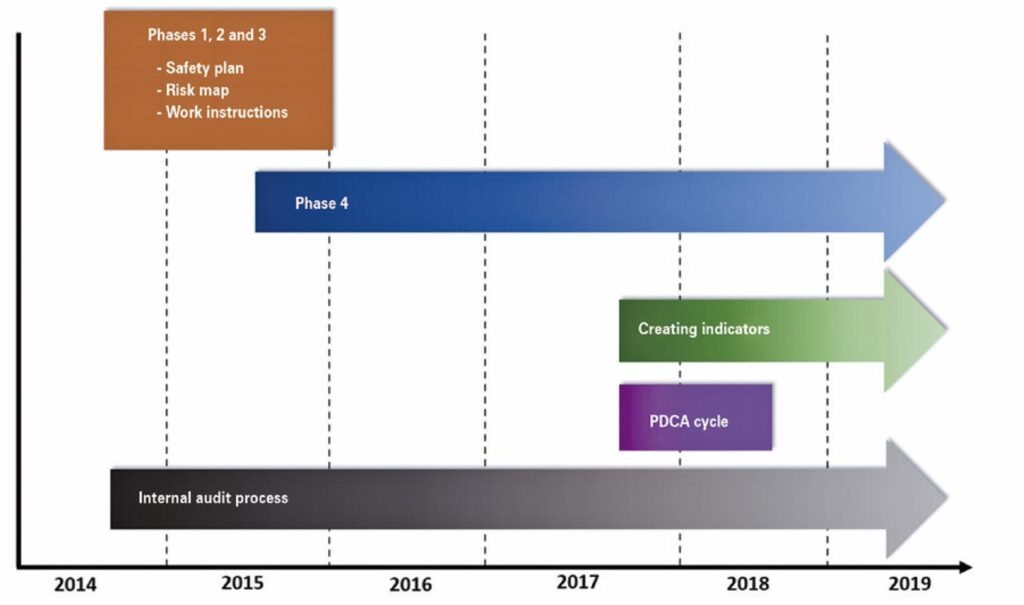
The unit was established in 2014, and the program was developed in four phases: creation of the safety plan, risk mapping, creation of work instructions, and incident management. Between December 2014 and December 2019, a total of 6,913 patients were monitored and 146 incidents were identified, with 44.52% classified as non-compliance to protocol, 20.54% as reportable circumstances, 13.69% as near-misses, 10.95% as no harm incidents, and 10.27% as adverse events (harmful incidents). Between 2017 and 2019, there was a reduction in amount of non-compliance to protocol (0.66% versus 0.42%; p=0.01) and reportable circumstances (0.5% versus 0.32%; p=0.32), with an increase in near-miss reporting (0% versus 0.07%; p=0.018). Throughout the study, there was an increase in adherence to indicator targets related to incident reporting, door-to-balloon time, and training hours.
Conclusion
The creation of Patient Safety Units, together with employing an effective plan, is an effective tool that contributes to the construction of a culture of excellence.
957