Rev. Bras. Cardiol. Invasiva.2017;25(1-4):16-21.

Renal sympathetic denervation with an irrigated-tip catheter: a feasibility study
DOI: 10.31160/JOTCI2017;25(1-4)A0005
ABSTRACT
Background:
Catheter-based radiofrequency renal denervation has emerged as a promising tool for blood pressure control in patients with resistant hypertension. The aim of the present study was to evaluate the feasibility and safety of percutaneous renal sympathetic denervation by radiofrequency ablation using an irrigated-tip catheter in patients with true resistant hypertension.
Methods:
A saline-irrigated catheter was used for renal sympathetic denervation. The sample consisted of a consecutive series of 11 patients with resistant hypertension based on office blood pressure measurements, confirmed by 24-hour systolic ambulatory blood pressure monitoring (ABPM) ≥ 135 mmHg.
Results:
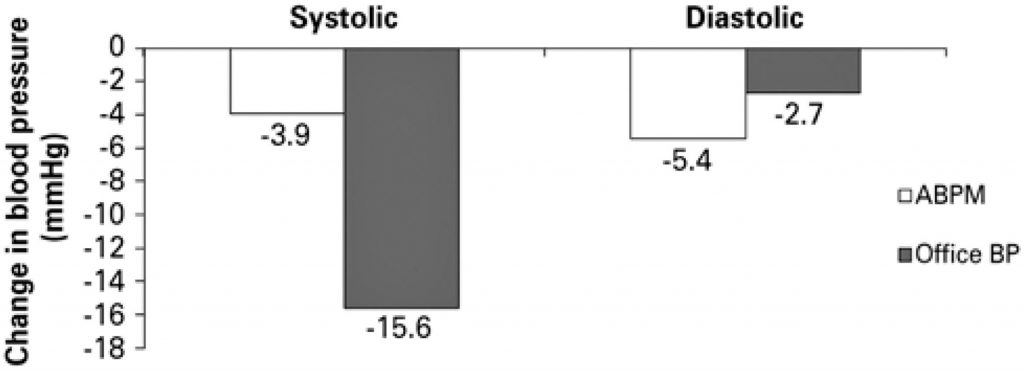
After 6 months of follow-up, there was a non-significant reduction of 3.9 mmHg (p = 0.49) and 5.4 mmHg (p = 0.19) in mean systolic and diastolic blood pressures, respectively, as measured by 24-hour ABPM. The mean office systolic blood pressure decreased significantly (182.1 ± 7.4 mmHg to 166.5 ± 7.7 mmHg; p = 0.03), while the mean office diastolic blood pressure did not change significantly (102.4 ± 5.5 mmHg to 99.7 ± 4.0 mmHg; p = 0.54). There was one case of dissection of a branch of the renal artery, which was treated with stent placement.
Conclusions:
Our study demonstrated the safety and feasibility of renal sympathetic denervation using a saline-irrigated catheter but failed in reducing blood pressure, as measured by 24-hour ABPM, in highly selective patients with true resistant hypertension.
Keywords: Catheter ablation; Denervation; Hypertension
392