Rev. Bras. Cardiol. Invasiva.2017;25(1-4):2-6.

Adequacy of elective coronary angiography indication for the diagnosis of coronary artery disease in the Brazilian public health system
DOI: 10.31160/JOTCI2017;25(1-4)A0002
ABSTRACT
Background:
The diagnosis of coronary artery disease is challenging because of the considerable variability in its clinical presentation. It also requires a cautious decision between invasive or conservative stratification. We aimed to evaluate the adequacy of coronary angiography indication in patients from the Unified Health System (SUS, in the Portuguese acronym) based on the guidelines for stable coronary disease.
Methods:
Consecutive patients who underwent coronary angiography between March 2014 and November 2015 were evaluated. Clinical presentation and functional tests were evaluated to define the class of recommendation. In quantitative coronary angiography, significant luminal obstruction was considered ≥ 50% and < 70%, while severe luminal obstruction was considered ≥ 70%.
Results:
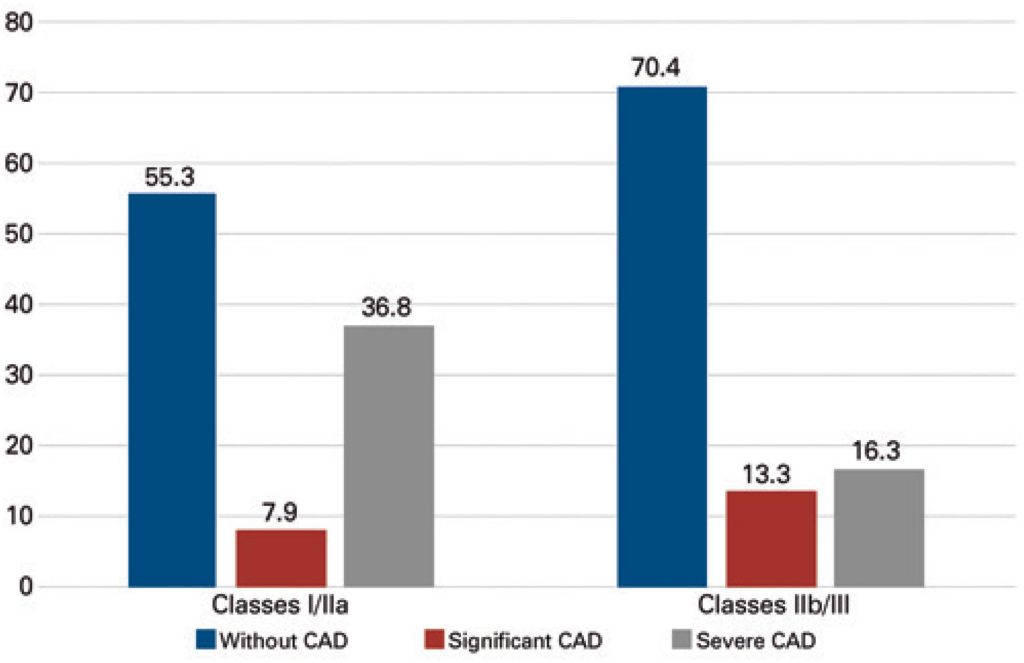
A total of 250 patients were included (52% male), with a mean age of 61.2 years. Of these, 35.2% had class II-IV angina. Exercise tests or myocardial scintigraphy with high-risk criteria were present in 22% and 10.8% of the sample, respectively. Among the patients, 61.2% did not present significant coronary artery disease. In addition, 60.8% had class I or IIa indication for coronary angiography, and 19.2% had a class III indication. Among the former, 44.7% had significant or severe coronary artery disease vs. 29.6% of those with recommendations IIb or III (p = 0.01). Class I or IIa indications were independently associated with the presence of coronary artery disease (OR = 1.91, 95% CI 1.02-3.56, p = 0.04).
Conclusions:
The adequacy of the indications for coronary angiography was only moderate, and the prevalence of coronary disease in the groups with class I or IIa recommendation was low. Difficulties regarding clinical evaluation and the adequate interpretation of functional tests may be one explanation for these findings.
Keywords: Coronary angiography; Coronary disease; Protocols
585