J Transcat Intervent.2023;31:eA20230011.
Comparison of two risk models in predicting contrast-induced nephropathy after coronary computed tomography angiography and percutaneous coronary intervention
Valentin Trevizani Neto
 , Layla Pasolini Lott
, Davi Muzi Rios
, Priscila Cabral Gomes Coelho Lima
, Mário Bazzarella
, Izabela Bernardes Muniz
, Sabrina Paiva Tavares Pereira
, Vitor Martinelli Batista Rolim
, Renato Giestas Serpa
, Osmar Araujo Calil
, Luiz Fernando Machado Barbosa
, Roberto Ramos Barbosa
, Layla Pasolini Lott
, Davi Muzi Rios
, Priscila Cabral Gomes Coelho Lima
, Mário Bazzarella
, Izabela Bernardes Muniz
, Sabrina Paiva Tavares Pereira
, Vitor Martinelli Batista Rolim
, Renato Giestas Serpa
, Osmar Araujo Calil
, Luiz Fernando Machado Barbosa
, Roberto Ramos Barbosa
DOI: 10.31160/JOTCI202331A20230011
ABSTRACT
Background
Contrast-induced nephropathy is one of the main causes of hospital-acquired acute renal failure. The Mehran risk score and the contrast medium volume used/creatinine clearance ratio could help identifying patients at higher risk of developing contrast-induced nephropathy. This study aimed to compare these two scores.
Methods
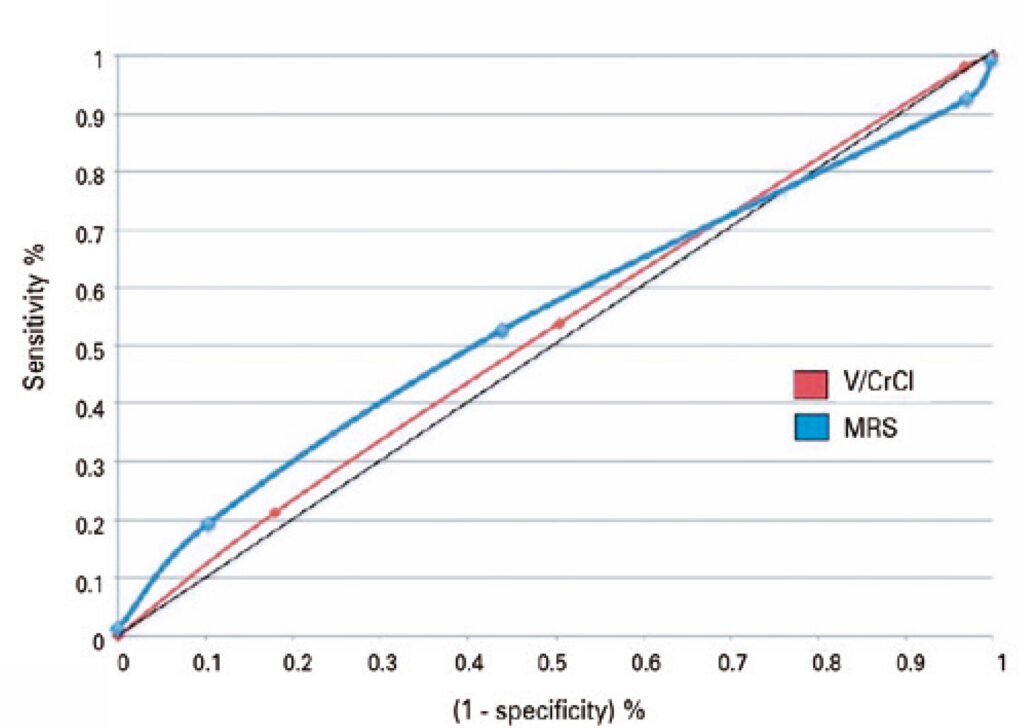
A retrospective, single-center observational study including hospitalized patients with baseline creatinine >1.3mg/dL, under observation for at least 48 hours after coronary computed tomography angiography and/or percutaneous coronary intervention. Mehran risk score and contrast medium volume used/creatinine clearance ratio were calculated for all patients, and the incidence of contrast-induced nephropathy was analyzed according to different cutoff points of both scores. Receiver Operating Characteristic curves were plotted to determine the accuracy of the methods in predicting contrast-induced nephropathy. The effectiveness of both methods was analyzed using Pearson’s correlation test.
Results
We included 102 patients and the incidence of contrast-induced nephropathy was 27.4%. The outcome occurred in 24.7% of patients when Mehran risk score ≥6, in 32.7% when Mehran risk score ≥10, and in 57.8% when Mehran risk score ≥15, in 28.7% of patients with contrast medium volume used/creatinine clearance ratio ≥2, 29.8% with contrast medium volume used/creatinine clearance ratio ≥3, and 34.3% with contrast medium volume used/creatinine clearance ratio ≥5. Receiver Operating Characteristic curves demonstrated area under the curve with moderate predictive capacity for Mehran risk score (0.7), and reduced/borderline for contrast medium volume used/creatinine clearance ratio (0.6). The correlation between the two scores was moderate.
Conclusion
Mehran risk score demonstrated greater accuracy in predicting contrast-induced nephropathy when compared to contrast medium volume used/creatinine clearance ratio, however both presented similar values. The cutoff points with the closest incidence between the two scores were ≥10 for Mehran risk score (32.7%) and ≥5 for volume used/creatinine clearance ratio (34.3%).
217