J Transcat Intervent.2018;26(1-2):a0013.
Manual thromboaspiration during primary percutaneous intervention in the Brazilian practice
DOI: 10.31160/JOTCI2018;26(1)A0013
ABSTRACT
Background
Manual thromboaspiration during primary percutaneous coronary intervention was very often used in the end of the last decade; however, there was a drop in its recommendation class due to results of recent publications. The objective of this work was to evaluate the use of this technique in Brazil.
Methods
Based on data from the Central Nacional de Intervenções Cardiovasculares (CENIC) in the period 2008 to 2016, we assessed patients submitted to primary percutaneous coronary intervention and manual thromboaspiration. The analysis was divided into three periods: 2008 to 2012 (P1), 2013 to 2014 (P2), and 2015 to 2016 (P3), according to the year of publication of the main studies on this subject.
Results
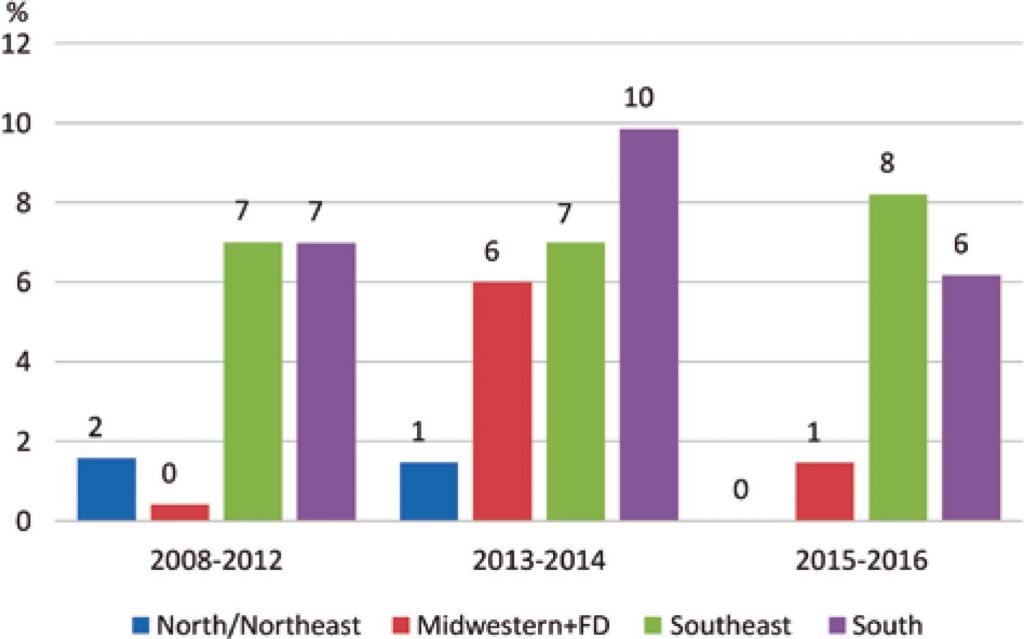
In this period, a total of 14,003 primary percutaneous coronary interventions were performed, and manual thromboaspiration was employed in 5.7% (P1), 6.1% (P2) and 5.6% (P3) of procedures. P3 had the lower proportion of hypertensive patients (44.2%, 41.3% and 27.7%; p=0.036) and smokers (64.1%, 69.4% and 50.8%; p=0.03), with higher prevalence of occluded arteries and lesions with visible thrombus on angiography. There was an increased use of thromboaspiration in the first period, with a peak of 8%, in 2012; whereas in 2016, it was only employed in 2% of cases (p<0.05).
Conclusions
The use of manual thromboaspiration during primary percutaneous coronary intervention was low in all periods analyzed, with a significant drop in 2016.
441