J Transcat Intervent.2019;27:e201815.
Transcatheter aortic valve replacement in patients aged ≥80 years
DOI: 10.31160/JOTCI2019;27A201815
ABSTRACT
Background
The objective of this study was to evaluate the impact of age ≥80 years on the clinical outcomes after transcatheter aortic valve replacement compared to patients aged under 80 years.
Methods
This is an observational study that assessed 86 patients with severe aortic stenosis that underwent to transcatheter aortic valve replacement.
Results
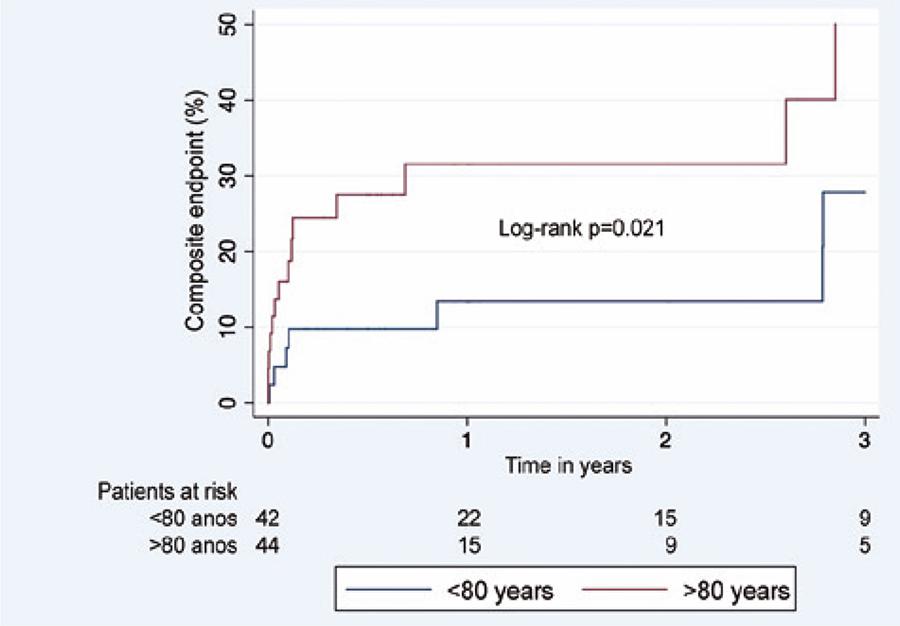
There was a greater incidence of total mortality in the group ≥80 years (p=0.043), as well as in the composite endpoint of total mortality, non-fatal myocardial infarction, and stroke (p=0.02). There was no difference between the groups regarding procedure success (90% vs. 95%; p=0.43), safety endpoints (34% vs. 21%; p=0.19), and 30-day efficacy (30% vs. 14%; p=0.09), as well as in the rate of vascular (11% vs. 12%; p=0.97) and hemorrhagic (14% vs. 9%; p=0.55) complications, and in length of hospital stay (9 vs. 7 days; p=0.31). There was a greater incidence of renal failure in the group ≥80 years (18.4% vs. 2.4%; p=0.04). After adjustments for relevant clinical factors, an age ≥80 years was no longer an independent predictor of mortality (p=0.06), but remained as an independent predictor of the composite endpoint (p=0.03).
Conclusion
Age ≥80 years, when adjusted for relevant clinical factors, is not an independent mortality predictor after transcatheter aortic valve replacement, but has a negative impact with an increase in incidence of adverse cardiovascular events and renal failure.
449